

The Curb Cut Effect
Its Application to Instructional Practices

We are caught in an inescapable network of mutuality, tied in a single garment of destiny. Whatever affects one directly, affects all indirectly.
- Dr. Martin Luther King, Jr.
We’ve all walked through them, and yet probably don’t notice until you need it – curb cuts in sidewalks. What’s the story behind how curb cuts came to be, and how can “the curb cut effect” apply to the ways we design learning experiences in our classrooms?
A Brief History of Curb Cuts
The first known curb cut was installed in Kalamazoo, Michigan, in 1945, thanks to the advocacy of Jack Fisher, a disabled veteran and lawyer. Like Fisher, a number of veterans were returning from World War II with mobility-related injuries and faced difficulties when it came to navigating sidewalks.1
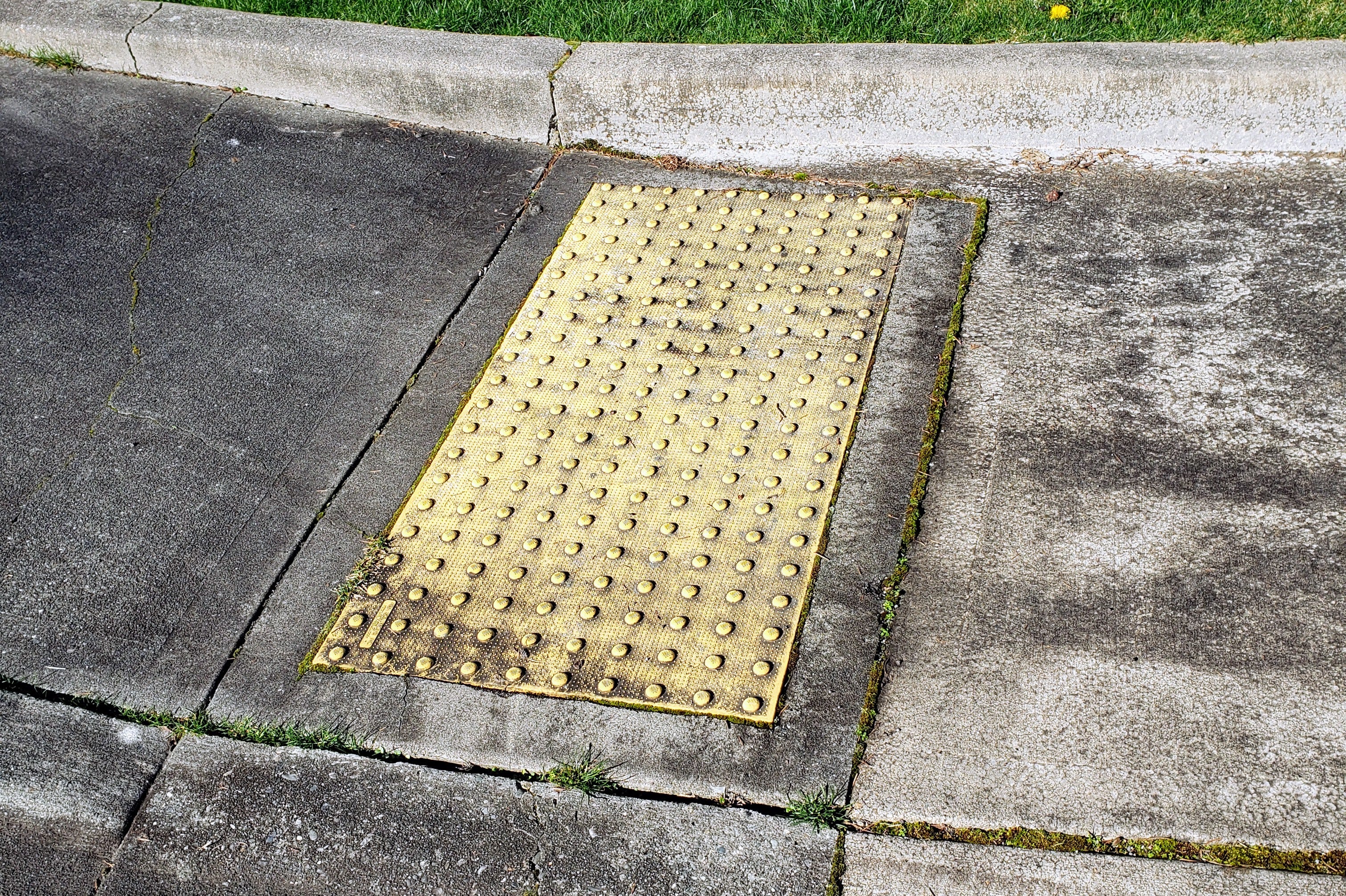
Later, throughout the 1960s-1970s, disability activists at the University of California, Berkeley, led a movement for accessibility throughout the campus. Part of this included establishing a wheelchair route throughout the UC Berkeley campus as well as the city of Berkeley. At the time, wheelchair users were navigating campus via driveways and loading docks, with some students planning their course schedule around which classes were downhill from the previous one.2 Taking direct action, Ed Roberts and the “Rolling Quads” created their own curb cuts throughout campus, either by taking a sledgehammer to the edges of sidewalks or by pouring concrete or asphalt to form ramps during the dark of night. In 1972, the city of Berkeley installed its first official curb cut on Telegraph Avenue, called, “the slab heard ‘round the world.”
Disabled advocates continued to push for access in public spaces, including supporting legislation to systematize access more universally. The Architectural Barriers Act in 1968 required that federally funded buildings be accessible for individuals with physical disabilities. This legislation paved the way for the passage of the more comprehensive Americans with Disabilities Act (ADA) in 1990, that includes, among many civil rights provisions, the requirements of curb cuts.3
The Curb Cut Effect
While curb cuts provided necessary access to wheelchair users, many other people have benefited on a daily basis – parents with strollers, travelers with luggage, delivery workers with crates or trolleys, bikers and skateboarders and many more. Even pedestrians unrestricted by wheeled devices used curb cuts regularly, often going out of their way to walk through them.4
Thus, “the curb cut effect” demonstrates that designing environments for vulnerable populations often has universal benefits. As Angela Glover Blackwell writes, “In fact, when the nation targets support where it is needed most—when we create the circumstances that allow those who have been left behind to participate and contribute fully—everyone wins. The corollary is also true: When we ignore the challenges faced by the most vulnerable among us, those challenges, magnified many times over, become a drag on economic growth, prosperity, and national well-being.”5
Put another way, working to meet the needs of one specific group doesn’t need to come at the expense of other groups; conversely, it can genuinely benefit them.
Some other examples of this effect include:
Closed captioning – designed for the deaf and hard of hearing; it is now also used in either noisy environments or quiet settings, and for learning new languages.
Audiobooks/Audio content – designed for blind people or those with low vision; it is now often also used for commuting, multi-tasking, and leisure listening.
Automatic doors – designed for wheelchair users; they are also used widely for parents with strollers, people moving large loads, and those with temporary injuries.
Application to Instructional Practices
With this in mind, how can we apply this principle to our instructional practices? What is necessary for some students that can end up benefiting everyone?
Coming from a different angle: If we designed lessons focusing on the students who struggle most to access them, what would change?
Here are some ideas to get started:
Using sentence stems on a regular basis – needed for multilingual learners and students with executive function challenges who struggle to get started and helpful for everyone to have a potential starting place
Processing time before answering a question with the whole class – necessary for students with different processing speeds and helps provide equity of voice and participation
Multiple ways to respond (talking, writing, drawing, etc.) – necessary for students with language or speech needs and enhances the agency and creativity of all students
Visual schedules – needed for students with autism and ADHD and beneficial for everyone to know what to expect
What other ideas are coming to mind?
Look closely at one classroom (or workplace) practice this week and ask: Who does this work well for, and who does it quietly exclude? How can the needs of the excluded be met (in ways that will likely benefit everyone)?
In case you missed it - related essays from Cultivating Justice:

Thanks for this informative post. What you have written about is a basic principle of a successful democracy. It was a concept that was central to the political thought of the founders of this country. When they talked about virtue, they primarily referred to civic or public virtue. In other words: The core principle of civic virtue was the importance of sacrificing one's personal interests and passions for the common good of the community. We know that a rising tide lifts all boats.
Love the curb cut analogy!